order, Iron Bison Resilience: A Manual for Tactical Maintenance, now available on amazon
Amateur at the Forge
True resilience is a trade to be mastered like a blacksmith at the forge, distinguishing between the hard work of building coping skills and the easy traps of comfort or painkillers. Even I still stumble in this process, proving that strength isn't about perfection, but the discipline to step back, assess the mistake, and pick up the right tool again.
Thomas E Gripp
3/8/20262 min read
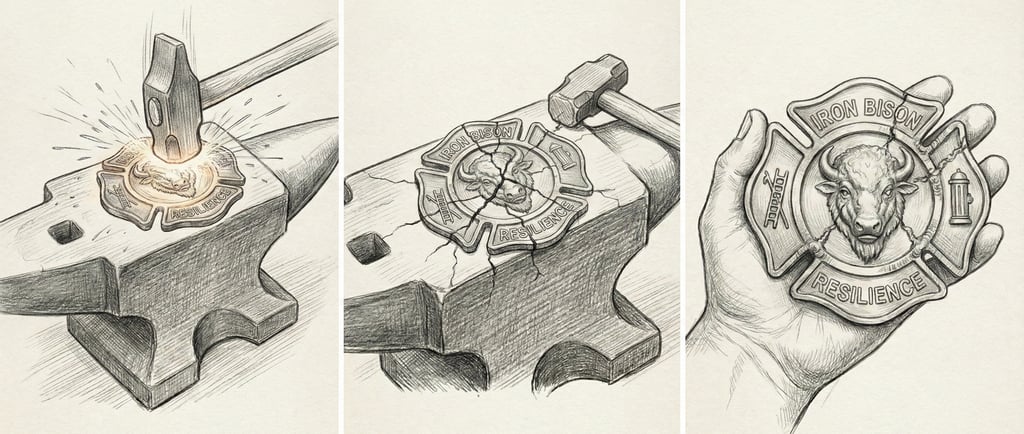
No one walks up to an anvil for the first time and forges a masterpiece.
You can stare at the hammer, the tongs, and the fire all day. You can read every manual on metallurgy in existence. But until you pick up that hammer and feel the heat on your face, you are not a blacksmith. You are just an observer.
The Iron Bison system is no different. You cannot simply "read" these tools and automatically master your resilience. It requires a teacher, it requires practice, and—most importantly—it requires the humility to admit when you’re doing it wrong.
The Trap of the "Easy" Fix
When we are in pain—whether physical injury or mental anguish—we develop habits based on survival. The body wants to protect itself.
We find the recliner, because it’s the easiest place to be.
We take the narcotic because it numbs the sensation.
It is easy to fool ourselves into thinking we are "surviving" our pain because we’ve found a way to mute it. But let’s be clear: Those are not tools. They are traps.
A tool is something you use to build, repair, or improve. A trap is something that holds you in place. A crutch might keep you upright, but if you lean on it forever, your muscles atrophy. The "recline" feels safe, but it is the enemy of momentum.
The Iron Bison Tools: A Practice, Not a Pill
Learning to use the Iron Bison tools to forge true coping skills takes time. Just like in the shop, some tools will feel natural in your hand immediately. Others will feel heavy, awkward, and frustrating. You will struggle with them.
That is part of the process.
If a blacksmith applies the wrong amount of heat or pressure, the raw material cracks. The metal is ruined, and he has to start over. In our lives, when we use the wrong coping mechanism—or neglect the tools entirely—our resilience cracks.
Even the Master Stumbles
I say this not as someone watching from the sidelines, but as someone standing at the forge with you. Even after developing the Iron Bison system, I still forget to use the tools.
Take my sleep schedule, for example. I know the science. I know the "tool" of rest is vital for recovery and mental fortitude. And yet, I still find myself neglecting it, letting old habits creep in, watching my own "raw material" start to crack under the pressure of fatigue.
I am not immune to the struggle just because I built the forge.
The Step Back
So, what happens when the metal cracks? What happens when you realize you’ve been in the recliner too long?
You don't quit. You don't burn down the shop.
You take a step back from the forge. You wipe the sweat (and maybe the tears) from your eyes. You assess what you are doing, admit you were using the wrong approach, and deliberately reach out to pick up the correct tool to fix the mistake.
Resilience isn't about never dropping the hammer. It’s about how quickly you pick it back up.ontent
Connect
Join the Iron Bison Herd for support and guidance.
CONTACT:
help@ironbisonresilience.com
913.205.5621
© 2025. All rights reserved.